Personal Computers
Are Not Done
Yet.
Aesthetic.Computer - a pitch for LACMA Art + Technology Lab 2026
Pitch by @jeffrey (Jeffrey Alan Scudder) · aesthetic.computer

§Application at a Glancesubmittable preview
Every field from the LACMA 2026 Art + Technology Lab application with its answer inline. Longer pieces link to their full sections below.
- Project name
- Aesthetic.Computer: Personal Computers Are Not Done Yet
- Three descriptive words
- instrument · library · network
- One-sentence description
- Aesthetic.Computer is a creative computing system and public device library (custom hardware, a handmade programming language, a social network, and a lending fleet of laptops for flashing custom creative OSes) that reimagines the personal computer as a live musical instrument for art.
- Full project description500 w · ours: 500
-
Personal computers have not been very personal. For forty years the form has been shaped by the companies that sold them: operating systems built to sell attention, software gatekept by app stores. The 1980s personal computing scene promised a computer that belonged to you, that you could program, that could do anything. Platform consolidation cut it short. Aesthetic.Computer bets a second personal computing scene is starting, and with tools this powerful in everyone's hands it will go wider and deeper than the first…
Read full 500-word pitch ↓ · PDF - Artist bio / CV
-
Jeffrey Alan Scudder is an artist, educator, and technologist based in Los Angeles. He loves building instruments and tools for other artists to use, and keeps a live and active practice across performance painting, software writing, and teaching. He holds an MFA from the Yale School of Art and a BFA from Ringling College of Art and Design. He has taught at UCLA, Parsons School of Design, and Southern Oregon University, and is currently Author in Residence at UCLA Social Software with Casey Reas and Lauren Lee McCarthy. He is the creator of Aesthetic.Computer, Whistlegraph, and No Paint, and his open-source tools No Paint and notepat each reached the front page of Hacker News. His work is held in the collections of KADIST (San Francisco) and SMK, the National Gallery of Denmark. He hosts biweekly NELA Computer Club demos at Plot.Place in Chinatown, Los Angeles.
Full CV in PDF ↓ - Artistic merit100 w · ours: 95
- Aesthetic.Computer treats the computer itself as an unfinished instrument, a site for ongoing artistic invention rather than a fixed consumer product. By building from the whole operating system (custom kernel, framebuffer rendering, sample-level audio synthesis), we recover the directness that early personal computing promised but commercial platforms abandoned. The work sits at the intersection of software art, instrument design, and language design: KidLisp is simultaneously a tool and a medium, and Aesthetic.Computer transforms commodity laptops into dedicated creative instruments. The artistic claim is that how we build computers is itself a creative act with cultural consequences.
- Technology + culture100 w · ours: 98
- Consumer operating systems have become attention-extraction machines, optimized for engagement metrics rather than creative agency. Aesthetic.Computer offers a counter-model: a computer that boots directly into art software and grows alongside the artist. Over five years of active development, Aesthetic.Computer's community has written 17,000+ KidLisp programs, made 4,400+ paintings, shared 2,900+ moods, and exchanged 19,000+ chat messages across 2,800+ registered handles. Aesthetic.Computer carries that social layer with it: chat, multiplayer, notepat, KidLisp runtime. The personal computer's design is a cultural question, not a settled technical one, and people show up when given the room.
- Public engagement100 w · ours: 95
- Public engagement happens through the AC Device Library. First, Flash Days where cohort artists and library members flash AC Blank laptops together and take them home. Second, KidLisp workshops where participants write generative art programs that run live on Aesthetic.Computer. Third, Family Play afternoons where visitors of any age borrow and play the library's fleet together. A public waitlist keeps the fleet moving. The entire software stack is free and open source on GitHub, and the library openly supports artists flashing their own custom creative OSes onto library hardware.
- Budget$50k cap · ours: $50k
-
Artist fee $22,000 (24 mo) · 2027 Symposium "boot the cohort" $2,500 · 2028 Demo Day "play the room" $3,000 · Paid event helpers $3,000 · Studio hardware $3,500 · AC Device Library fleet (12 AC Blanks × $128, cases + shipping + returns) $2,000 · Mini Rig speakers + peripherals $1,100 · Install fabrication $2,500 · Workshop materials $1,200 · Server infra $3,500 · Docs + translation $2,000 · Contingency $3,700. Total $50,000, the full cap.
Full budget ↓ - Other funding
- Open-source sponsorship via GitHub Sponsors and Liberapay supplements ongoing infrastructure (hosting, domains, CI). No other institutional grant support at this time.
- Timeline24 months · two leads
-
Two public events, one sentence each.
2027 Symposium · "We boot the cohort." Cohort artists and library members flash AC Blanks together at a public Flash Day and take them home; a public KidLisp workshop takes participants from first line of code to a running program on the museum floor.
2028 Demo Day · "We play the room." A multi-station Aesthetic.Computer installation premieres on the LACMA floor; Family Play afternoons open the library fleet to visitors of any age; v1.0 of the open-source build pipeline ships so any institution can run its own room.
Full calendar ↓ - Imagesup to 5 · JPEG
-
The five JPEGs staged for upload, inline so you can see them the way a reviewer will:
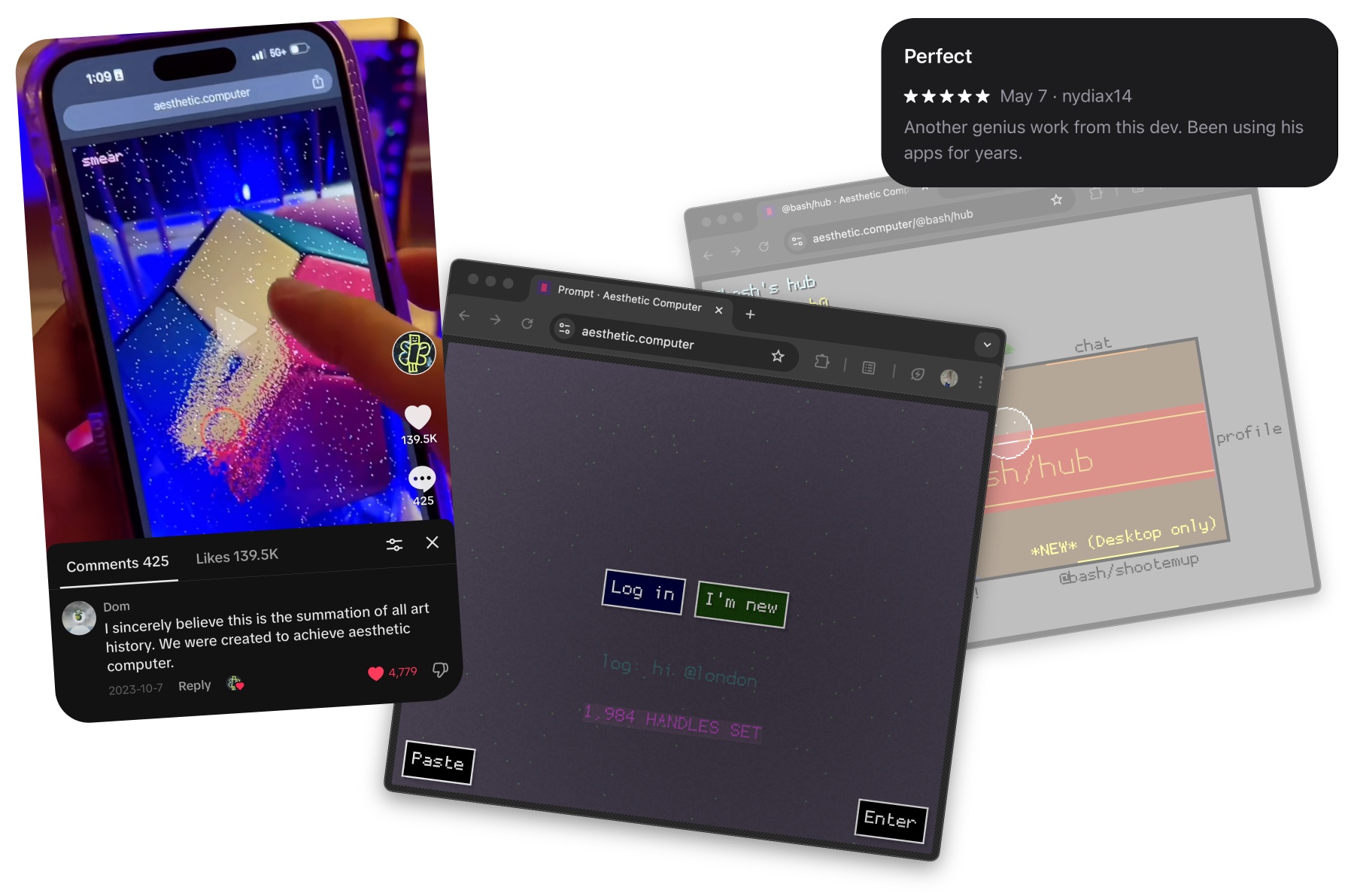
1 · platform-screenshot.jpgAesthetic.Computer on mobile + desktop. 2,862 registered users; 600+ pieces. 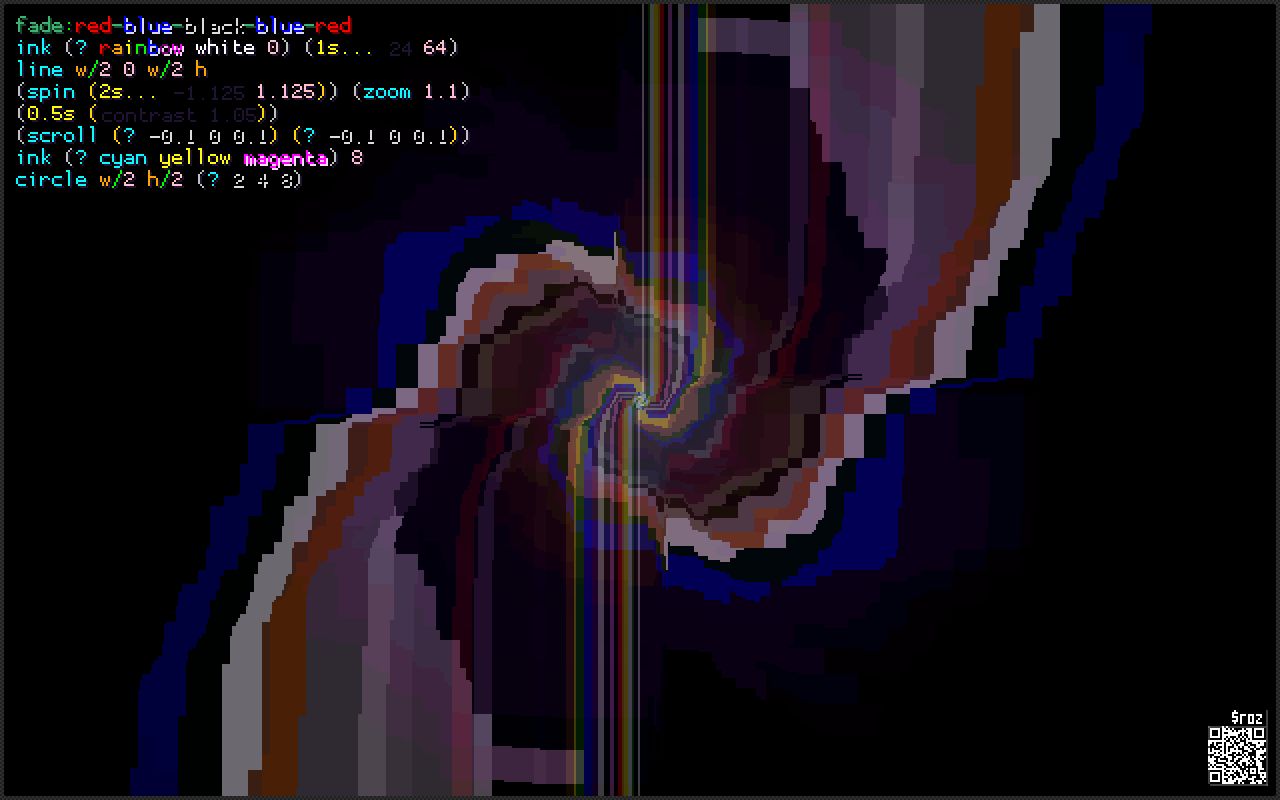
2 · kidlisp-featured.jpg$roz by @jeffrey, a KidLisp piece with 6,000+ plays. 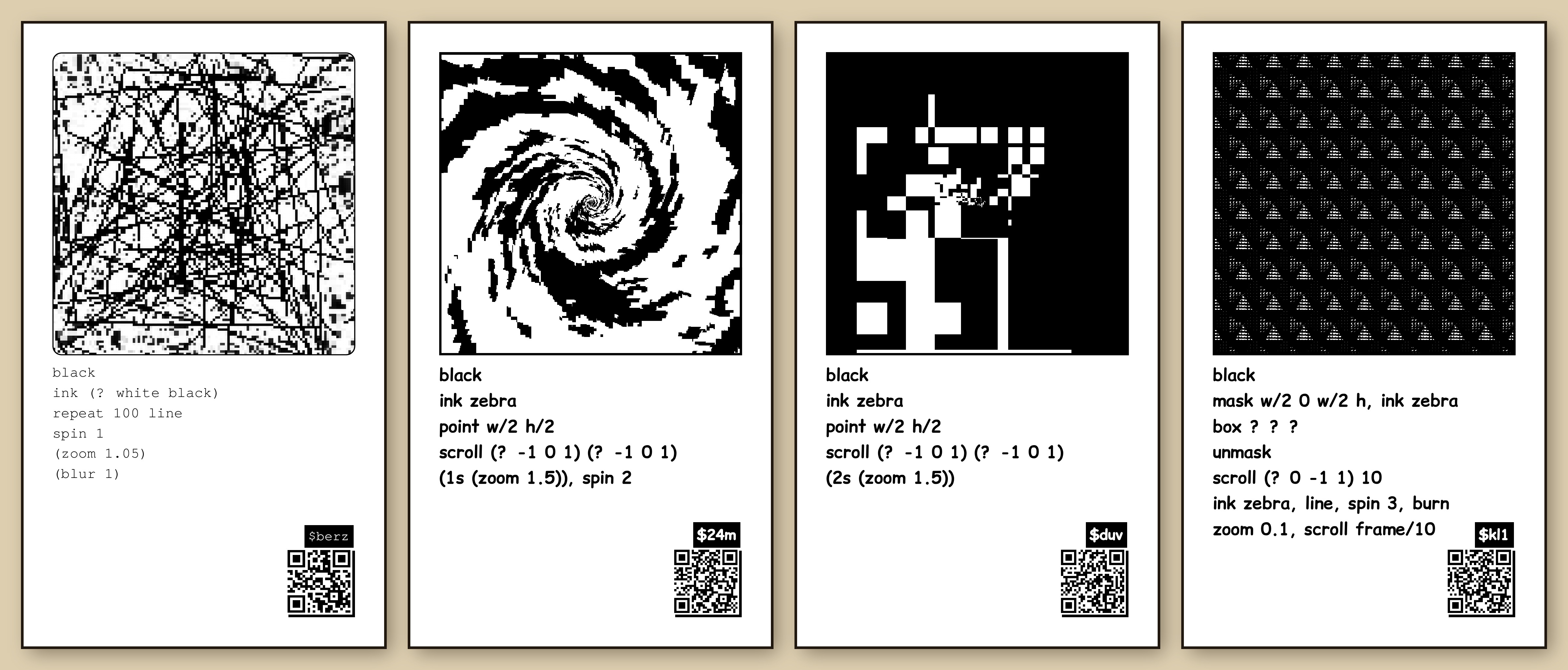
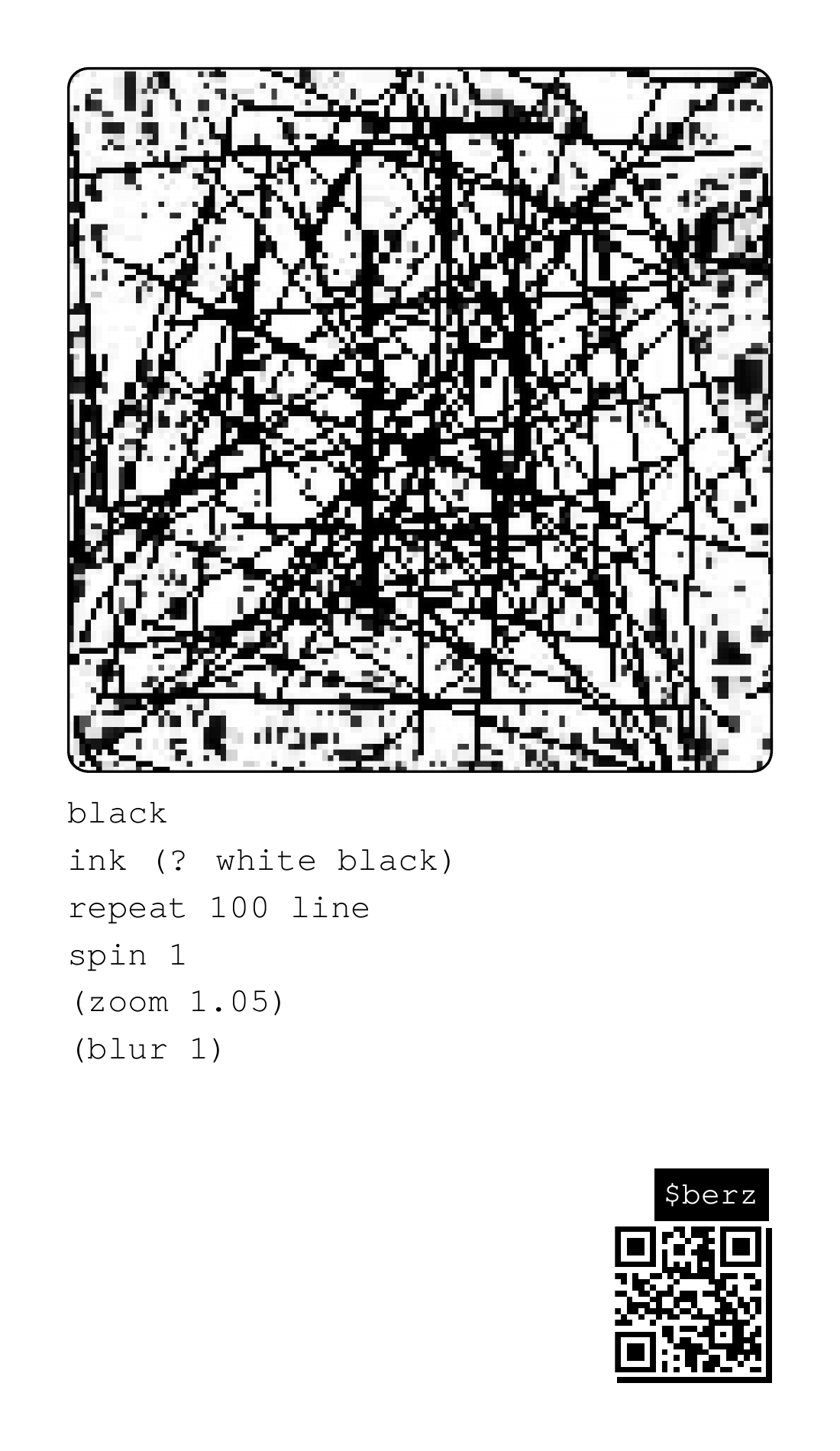
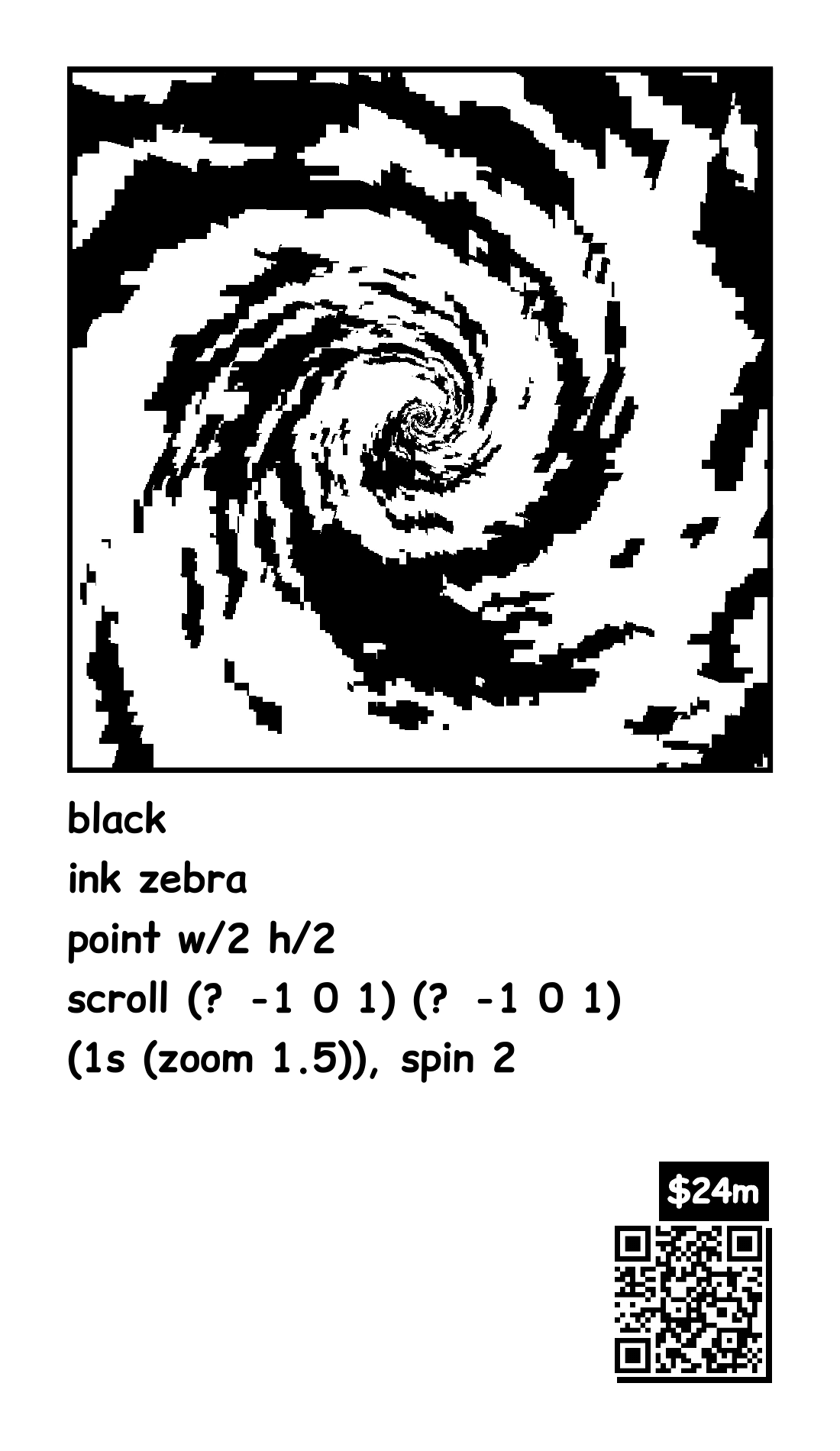
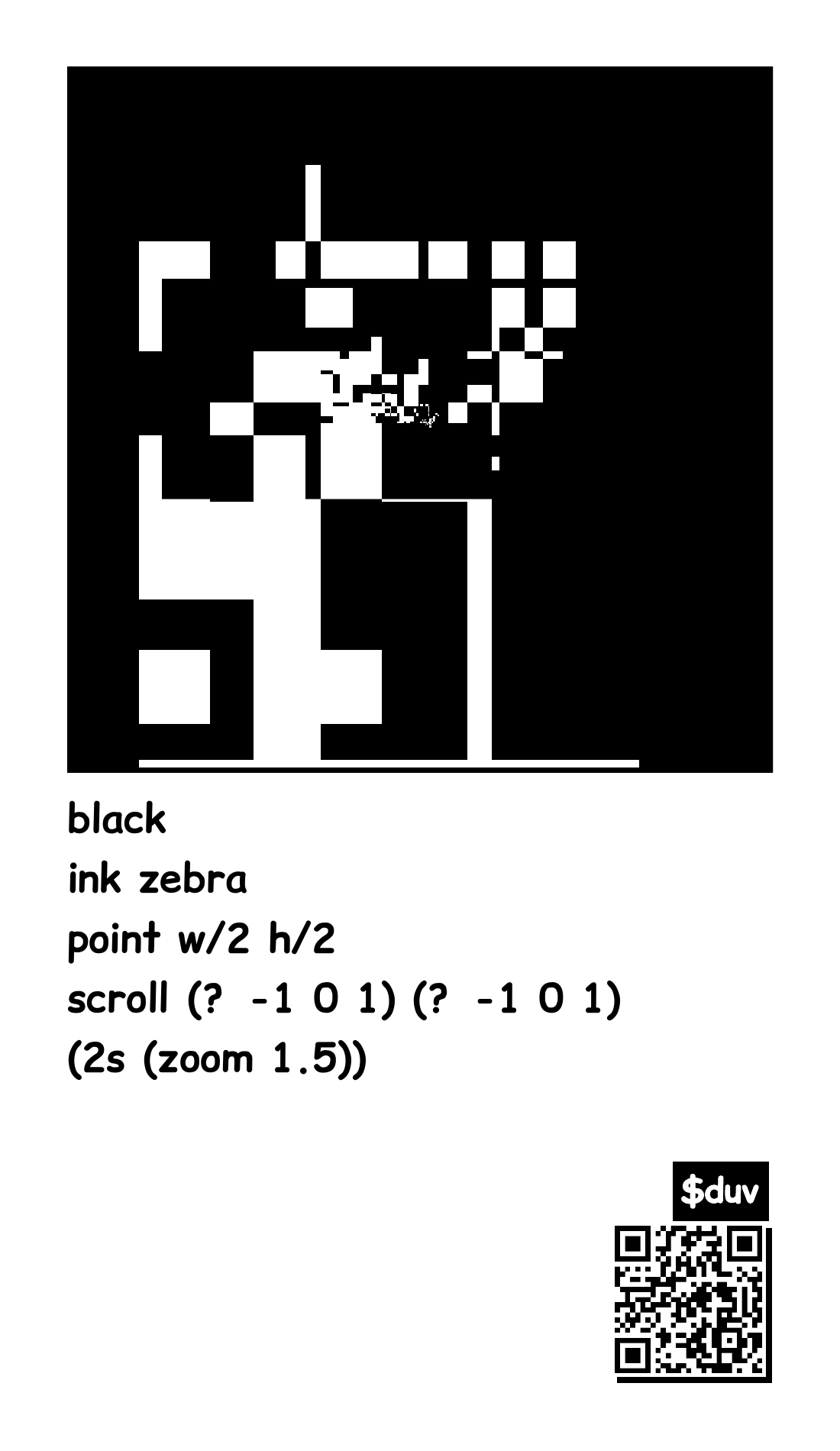
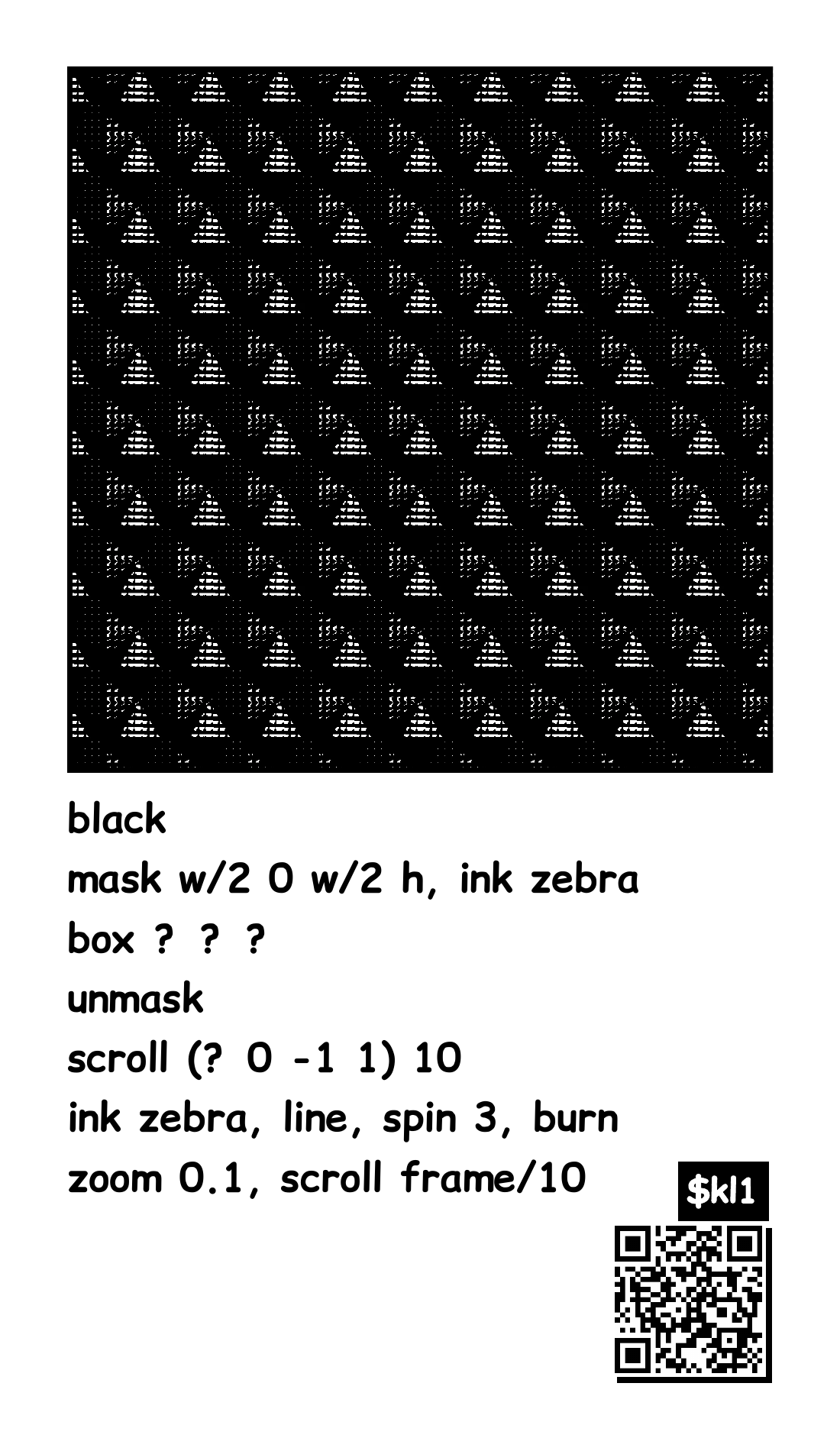
3 · card-gallery.jpgFour KidLisp pieces as printable cards ($berz, $24m, $duv, $kl1). 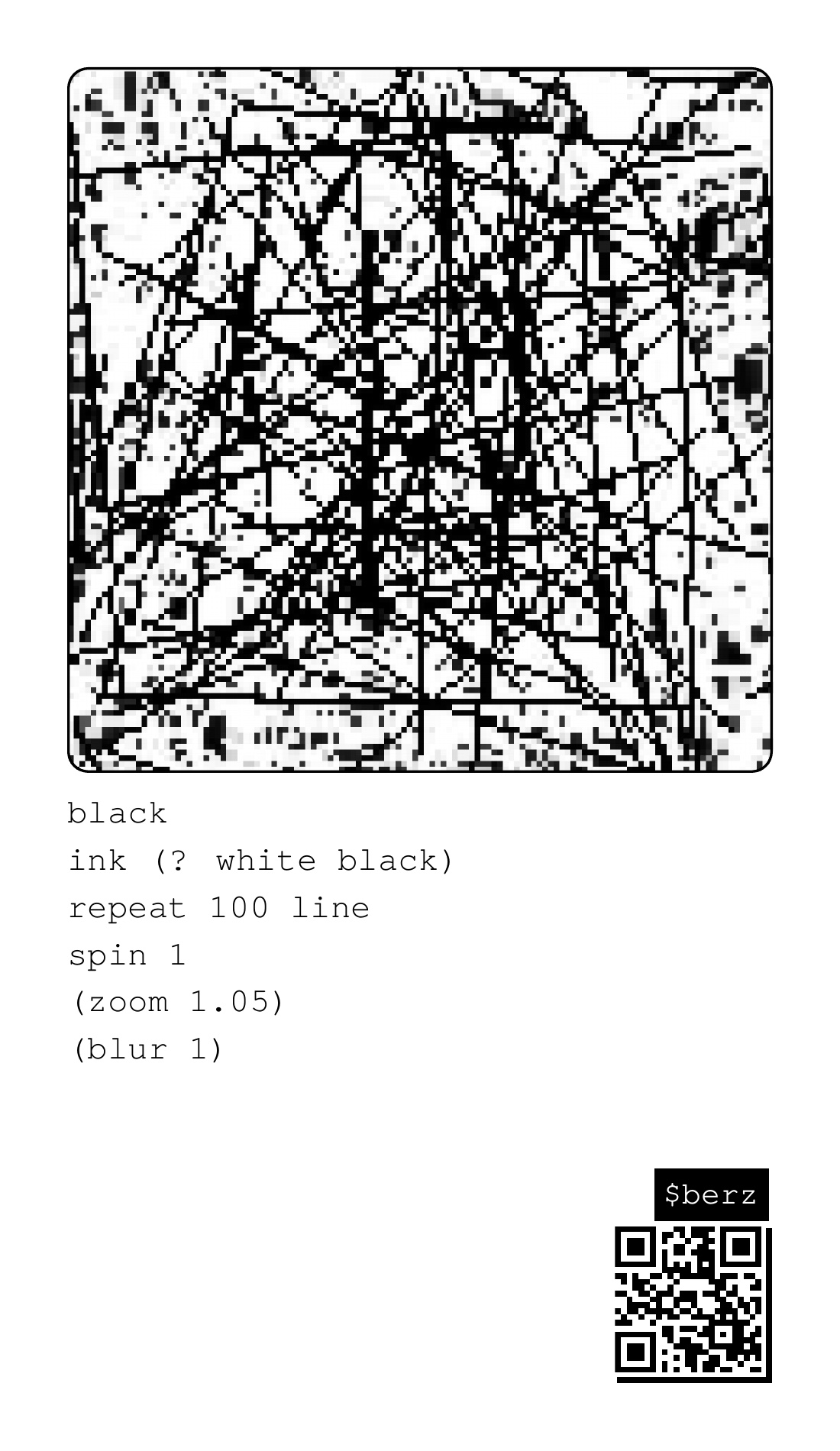
4 · card-berz.jpgThe $berz card, up close. 6 lines of KidLisp. 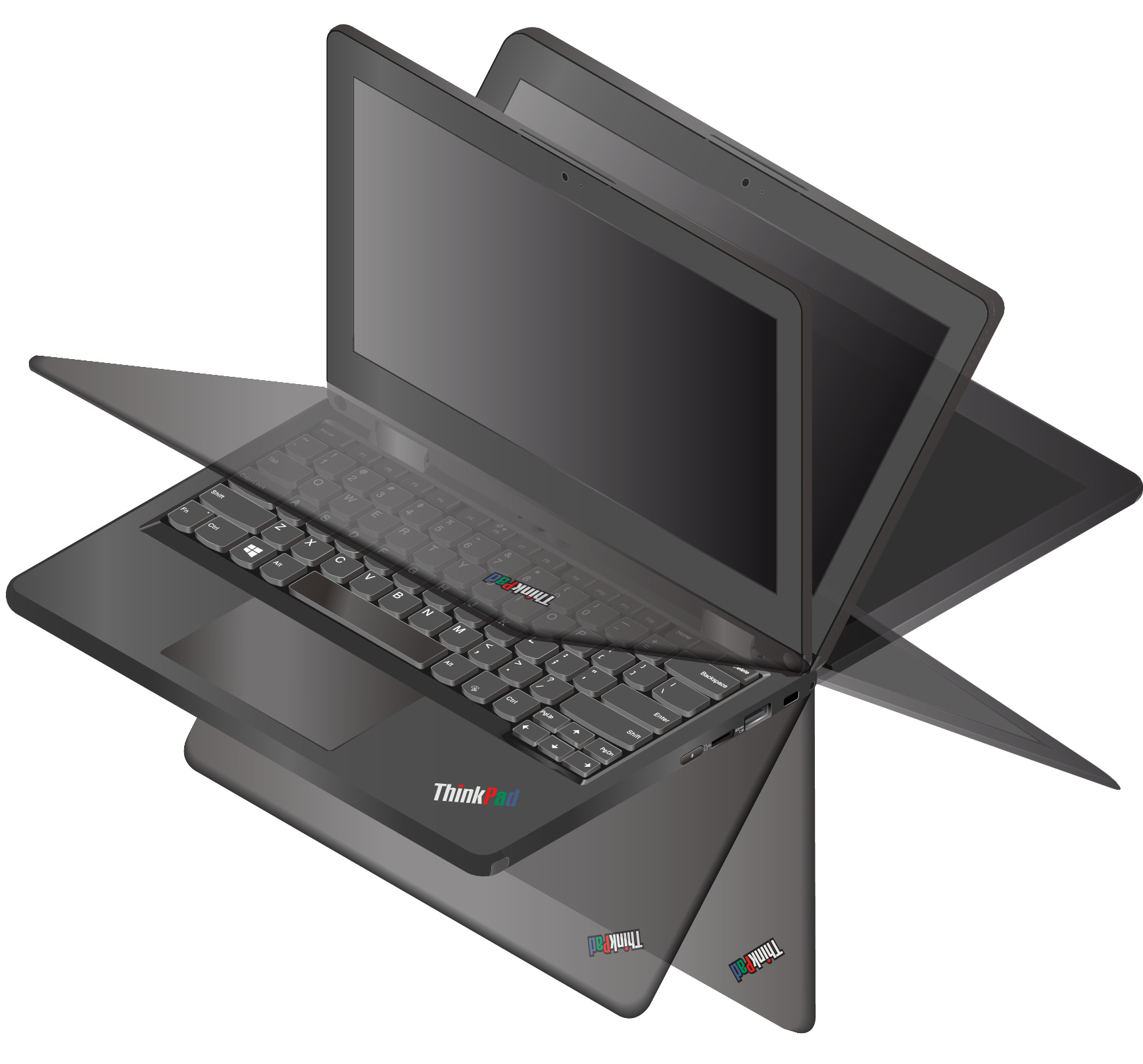
5 · hardware-yoga.jpgTarget hardware: Lenovo Yoga running Aesthetic.Computer from USB. - Videounder 5 min · optional · ours: 22 s
- Two cuts of the same 23-second demo, captured natively from Aesthetic.Computer hardware. An ambient loop (muted, plays silently on page load) and a narrated + captioned version (voiceover + baked-in subtitles) produced by a reusable pipeline at tools/vo-pipeline.mjs. Watch above ↑. A longer cut with prompt-transitions and a shutdown "bye @jeffrey" animation (still being written in C for the native binary) is the next capture. Narration script: demo-narration.md.
- Lineage checkpast Lab cohort
- Two recent Lab recipients co-teach UCLA's Social Software course where Jeffrey is Author in Residence: Casey Reas (2023, METAVASARELY and An Empty Room) and Lauren Lee McCarthy (2022, Auto). Lineage below ↓ · All 45 recipients
Extended referencepitch · registers · metrics · features · cards · lineage · calendar · budget · papers
§Pitch
Personal computers have not been very personal. For forty years the form has been shaped by the companies that sold them: operating systems built to sell attention, software gatekept by a handful of app stores. The 1980s personal computing scene promised a computer that belonged to you, that you could program, that could do anything. Platform consolidation cut it short.
Aesthetic.Computer bets a second personal computing scene is starting, and with tools this powerful in everyone's hands it will go wider and deeper than the first. Wider because anyone can publish. Deeper because anyone can write a language, modify a kernel, or put an AI coding partner to work on a single piece.
Aesthetic.Computer has three interlocking layers (an operating system, a custom programming language called KidLisp, and a social network) and a public face: the Library. The whole stack is free and open source on GitHub. There has never been a better time to develop new software for old hardware. Windows 10 end-of-life has stranded roughly 240 million x86_64 laptops; 62 million tonnes of e-waste pile up each year. Strip away the consumer OS and those machines become a planetary population of half-built instruments waiting for a kernel.
Aesthetic.Computer is the kernel.A Linux boot runs a custom C runtime as PID 1 on x86_64 UEFI laptops, with no desktop, no window manager, no browser. It renders graphics through DRM without a compositor, reads input from raw evdev streams, and synthesizes audio sample-by-sample through ALSA at 192 kHz with 32-voice polyphony. Per-seat cost lands near $50, two orders of magnitude below Princeton's PLOrk laptop-orchestra model ($1,500+/seat hand-fabricated), and 15× below Virginia Tech's L2Ork ($750/seat Linux). The laptop-orchestra movement settled the artistic question in year one; what it failed at was access. Aesthetic.Computer escapes that constraint.
A built-in code command drops into a native terminal running Anthropic's Claude Code, so artists can ask an AI coding partner to modify a piece without leaving the OS. The default piece is notepat, an 8,466-line polyphonic instrument with eight waveforms, sample recording, and USB + UDP MIDI. Twenty other pieces ship alongside it.
A minimal Lisp dialect designed specifically for generative art. 118 built-in functions across 12 categories, accessible to non-programmers yet expressive enough for complex compositions. KidLisp programs can be minted as on-chain "keeps" on Tezos, establishing provenance without requiring artists to understand blockchain infrastructure.
The Network ties it together.Aesthetic.Computer hosts hundreds of built-in pieces across thousands of registered handles (see live counts below). Every piece is URL-addressable and instantly shareable via QR code. The platform supports real-time multiplayer through WebSocket and UDP channels, so people can draw, compose, and play together. The website has been in active development since 2021 (19,000+ commits across 5 years); Aesthetic.Computer is new, its kernel prototype landing February 2026.
The Library is what makes it civic.A lending fleet of AC Blank laptops (refurbished ThinkPad 11e Yoga Gen 6, flashed with Aesthetic.Computer at $128/seat) circulates through Flash Days, workshops, and Family Play afternoons at LACMA. Members join a public waitlist. Aesthetic.Computer is the flagship; the library welcomes artists flashing their own custom creative OSes onto library hardware, joining a tradition of artist-run device libraries. The library is how the stack gets into hands.
What happens in the grant period.At the 2027 Symposium we boot the cohort: cohort artists and library members flash AC Blanks together at a public Flash Day and take them home; a public KidLisp workshop takes participants from first line of code to a running program on the museum floor. At the 2028 Demo Day we play the room: a multi-station installation premieres on the LACMA floor, Family Play afternoons open the library fleet to visitors of any age, and v1.0 of the open-source build pipeline ships alongside so any institution can run its own room.
The full 500-word pitch and statements live in lacma-2026.pdf.
§Three Registers
A Linux kernel that boots as one piece of art software. 32-voice synthesis at sample-level precision. A keyboard becomes a synthesizer; a laptop becomes a sitting-down instrument. No desktop, no browser, no distraction.
KidLisp: 118 built-in functions, no build step, no imports. A child can write one. Over 17,000 programs already live on the platform. A language designed for artistic expression rather than industrial production.
Every piece is URL-addressable. Every URL is a QR code. Real-time multiplayer through WebSocket + UDP. 2,800+ handles. Pieces can be minted on Tezos. A self-publishing creative commons.
A lending fleet of AC Blank laptops ($128/seat, flashed with Aesthetic.Computer) circulating through Flash Days, workshops, and Family Play afternoons. Public waitlist. Welcomes other custom creative OSes. Artist-run device-library tradition.
§The Network, Right Nowlive from aesthetic.computer/api/metrics
§Aesthetic.Computer · Current Feature Setx86_64 UEFI · PID 1
code command spawns Anthropic's Claude Code as a PTY subprocess inside a native terminal emulator. Modify a piece without leaving the OS.§KidLisp as Printable Cards2.75″ × 4.75″ · monochrome
Four recent pieces as printable cards, produced for Casey Reas & Lauren Lee McCarthy's Social Software course at UCLA (Spring 2026). Each card is a complete, self-contained KidLisp program: pixel output at top, full source below, QR code linking back to the live piece.
§The Lineagespecific, not canonical
§Calendaraligned to LACMA's biennial cadence
The Lab's new structure sets two public events: a 2027 Symposium (works-in-development) and a 2028 Demo Day (completed projects). Our lead for each: at Symposium we boot the cohort, at Demo Day we play the room.
§Budget$50,000 requested · full cap
Event-tied line items in pink (Symposium, Demo Day, paid helpers). Artist fee covers the full 24-month arc from Fall 2026 through Fall 2028. The 10% contingency line absorbs slip; the helper line is a direct expense for the two cohort events.
§This Lab's Lineage45 projects · 2014–2023
A few Art + Technology Lab projects that mark out the territory this proposal enters. Full reference list in the repo homework file.
§Submission-Form Version~200 words
Aesthetic.Computer: Personal Computers Are Not Done Yet. The 1980s personal computing scene promised a computer that belonged to you; platform consolidation cut it short. AC bets a second scene is starting, with tools powerful enough to go both wider and deeper than the first.
Aesthetic.Computer is a Linux kernel that boots directly into art on x86_64 UEFI laptops, running a custom C runtime as PID 1, with no desktop, no window manager, no browser. 32-voice audio at 192 kHz, DRM graphics, raw evdev input. A built-in code command drops into a terminal running Anthropic's Claude Code, so artists can ask an AI coding partner to modify a piece without leaving the OS. The default piece is notepat, an 8,466-line polyphonic instrument.
KidLisp is a minimal Lisp with 118 functions. 17,000+ programs already written. Programs can be minted on Tezos without artists touching blockchain infrastructure.
With LACMA support we grow the AC Device Library: a lending fleet of AC Blanks (refurbished ThinkPad 11e Yoga × $128) flashed with Aesthetic.Computer, circulating through a public waitlist. The library welcomes artists flashing their own custom creative OSes, joining a tradition of artist-run device libraries. At the 2027 Symposium we boot the cohort (Flash Day + KidLisp workshop); at the 2028 Demo Day we play the room (multi-station installation + Family Play + v1.0 release).
§The Academic Spinearxiv series · papers/
Every claim in this proposal is backed by a short paper in the AC arxiv series. Published versions live at papers.aesthetic.computer; drafts and source are in the repo.
§Status✅ submitted · 2026-04-22
- Proposal drafted · lacma-2026.pdf (2.0 MB, 13 pages incl. CV + call-for-proposals appendix).
- Stats refreshed to current live numbers; Aesthetic.Computer claims audited for accuracy (no aspirational <2s boot, honest DRM + Claude Code framing).
- Figures: sosoft-style KidLisp cards replace the old "educational poster" figures.
- 5 JPEG images staged in
grants/lacma-2026/jpegs/submit/. - Credentials front-loaded: Yale MFA, KADIST + SMK collections, HN × 2, Casey Reas residency at UCLA.
- Timeline + budget anchored to the Lab's announced 2027 Symposium and 2028 Demo Day.
- Research: 45-recipient Lab-recipients reference file compiled; Reas (2023) identified as nearest lineage precedent.
- This page · aesthetic.computer/lacma-2026.
- 86-second grant video · ElevenLabs voice clone, animated KidLisp backgrounds, burned captions · grant-video.mp4.
- Submitted to Submittable · PDF proposal, budget, five images, and grant video attached · Wed 2026-04-22 before 11:59 PM PST.